In this article
- It Started With a Mess Bill
- Gujarat Was the Beginning. Bihar Was the Escalation.
- When India Came to a Standstill
- The Year That Disappears From Arun Jaitley's Biography
- The BJP's Own Origins
- A Question That Is Rarely Asked
- JP's Most Controversial Appeal
- The Hypocrisy, Named
- The Angry Young Person in the Mirror
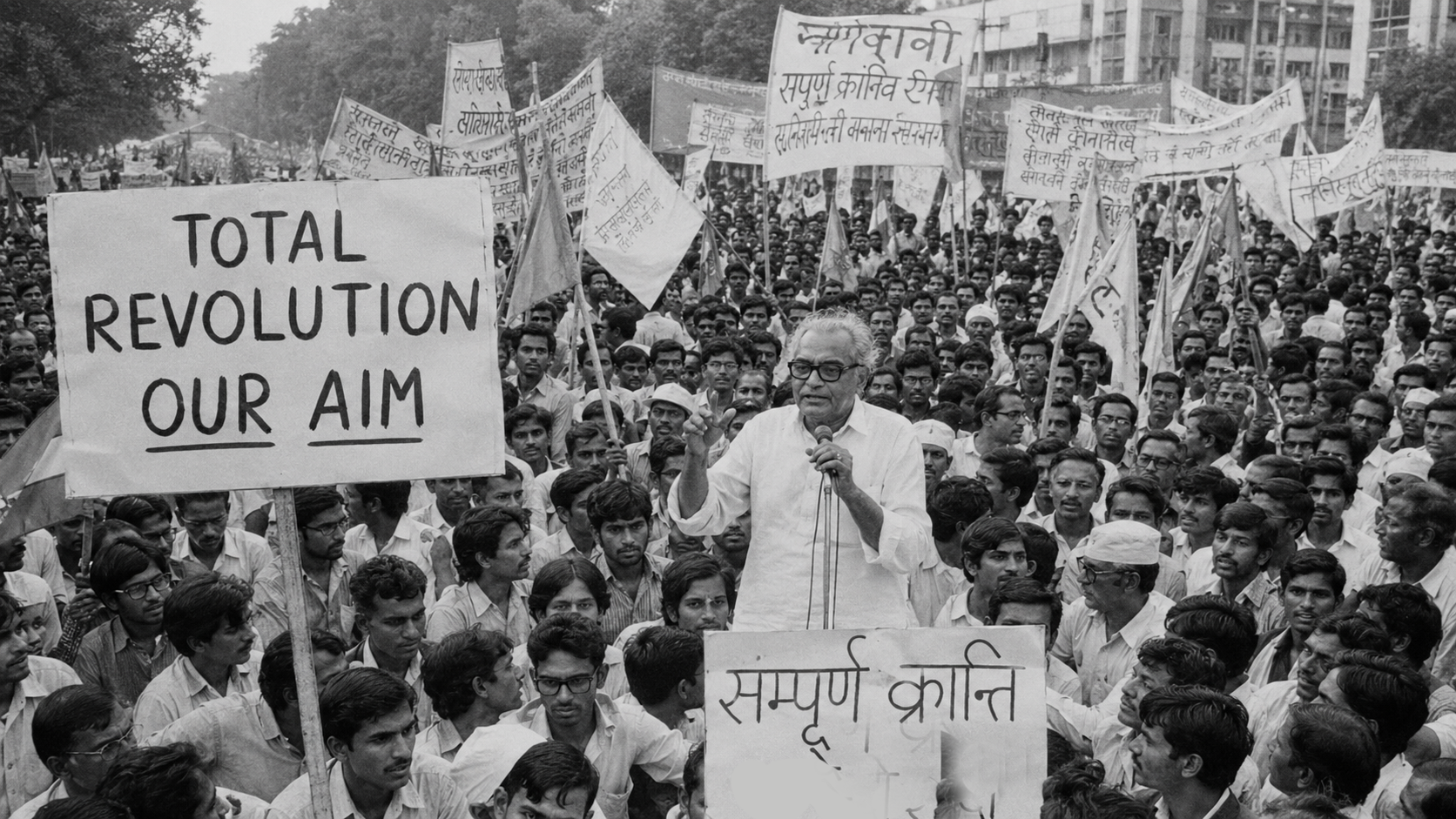
One of the greatest ironies of contemporary Indian politics is that many of the people who today portray student protests as anti-national, anarchic or a threat to democracy built their own political careers through exactly such protests.
The history is not forgotten because it is unimportant.
It is forgotten because it is inconvenient.
Young Indians are increasingly encouraged to believe that patriotism means obedience, that criticism weakens the nation, and that protest is somehow incompatible with democracy. Yet India's democracy was shaped not only inside Parliament but also on the streets, inside universities, through trade unions, and by millions of ordinary citizens who challenged those in power.
Ironically, one of the greatest beneficiaries of that democratic tradition is the very political movement that today often appears most uncomfortable with it.
The story did not begin with the Emergency.
It began nearly two years earlier.
It Started With a Mess Bill
On 20 December 1973, students at the Lalbhai Dalpatbhai College of Engineering in Ahmedabad went on strike after hostel food charges were increased by around twenty percent. The increase amounted to only about twenty rupees a month, but inflation was soaring, food subsidies had been withdrawn, and frustrations had already been building.
A canteen bill lit the spark. Within weeks, Gujarat was in turmoil.
On 3 January 1974, protests spread to Gujarat University. Police responded with lathi charges, tear gas and mass arrests. Instead of suppressing the agitation, the crackdown transformed it into a wider public movement.
Lawyers joined.
Professors joined.
Middle-class citizens joined.
The Nav Nirman Yuvak Samiti emerged to coordinate the protests, and what had begun as a student grievance soon became a movement against corruption and the Congress government led by Chief Minister Chimanbhai Patel, who had earned the street nickname "Chiman Chor."
This was no symbolic demonstration.
Statewide strikes shut down large parts of Gujarat. Violent clashes erupted across dozens of towns. Curfews were imposed. Public transport was attacked. Government offices were damaged. Buses were burned. Incidents of looting and arson occurred. By the end of January, the Army had been deployed in Ahmedabad to restore order.
When the agitation finally subsided in March 1974, more than one hundred people had lost their lives, hundreds had been injured and thousands had been arrested.
Most significantly, the movement achieved something unprecedented in independent India.
It forced the resignation of an elected Chief Minister, led to the dissolution of the Gujarat Legislative Assembly and resulted in President's Rule.
A student-led movement had successfully brought down a democratically elected state government.
Among the organisations supporting the movement were the Akhil Bharatiya Vidyarthi Parishad, the Bharatiya Jana Sangh and Congress (O). The Sangh Parivar was not an observer. It was an active participant.
Gujarat Was the Beginning. Bihar Was the Escalation.
Inspired by Gujarat, students in Bihar formed the Bihar Chhatra Sangharsh Samiti in early 1974.
Initially, the issues were familiar.
Corruption.
Inflation.
Unemployment.
Administrative failure.
Soon, however, the movement found its leader in veteran freedom fighter Jayaprakash Narayan.
On 5 June 1974, before a massive gathering at Gandhi Maidan in Patna, JP gave the speech that would define an entire political generation.
He declared that this was no longer merely a campaign against one state government.
It was a call for Sampoorna Kranti, Total Revolution.
The objective had expanded from removing the Bihar government to fundamentally transforming India's political system and ultimately replacing the government led by Prime Minister Indira Gandhi.
Students became the centrepiece of this revolution. JP described them as Yuva Shakti, the moral force capable of holding governments accountable when institutions failed. Today that phrase is remembered with admiration.
One has to wonder whether it would be treated with equal admiration if spoken by an opposition leader today.
When India Came to a Standstill
Just weeks before JP's call for Total Revolution, India witnessed another extraordinary confrontation with the government.
In May 1974, nearly 1.7 million railway workers led by trade union leader George Fernandes launched what remains the largest industrial strike in independent India's history.
For twenty days, from 8 May to 27 May, railway operations across much of the country were severely disrupted.
This was an India without budget airlines, expressways or widespread private vehicle ownership.
For ordinary Indians, the railway was the country itself.
Students travelled by rail.
Workers travelled by rail.
Patients travelled by rail.
Food moved by rail.
Entire families depended upon it.
The strike effectively paralysed large parts of the nation.
The government responded with mass arrests, dismissals, evictions of railway employees and deployment of the Army to maintain essential services.
Although the railway strike was organised independently of JP's movement, it became part of the broader atmosphere of nationwide resistance to the government that defined 1974.
Mass disruption was not condemned as inherently anti-national.
For many in the opposition, it was celebrated as democratic resistance.
The Year That Disappears From Arun Jaitley's Biography
Among the young leaders emerging during this period was a twenty-two-year-old law student from Delhi University.
His name was Arun Jaitley. He was not watching events from the sidelines. He travelled between Ahmedabad and Patna, worked closely with the student movement and rose rapidly within the Akhil Bharatiya Vidyarthi Parishad. In 1974, he became President of the Delhi University Students' Union and later National Convener of the Chhatra Sangharsh Samiti, coordinating student organisations participating in the nationwide agitation. He was part of a movement that organised demonstrations, strikes, gheraos and sustained public campaigns explicitly intended to force elected governments from office.
Yet many official biographies of Jaitley move almost directly from student politics to June 1975, when the Emergency was declared and he was imprisoned. His incarceration deserves to be remembered.
So does the year that came before it.
Because without 1974, one cannot understand either Arun Jaitley or the rise of the political tradition he later came to represent.
Read this for more on this topic: Inside the Emergency: The 'mess' that triggered India's darkest hours
The BJP's Own Origins
The Bharatiya Janata Party did not emerge from nowhere in 1980.
Its immediate predecessor, the Bharatiya Jana Sangh, was one of the principal political forces within JP's coalition.
RSS's student wing, the Akhil Bharatiya Vidyarthi Parishad, was deeply embedded within the student agitations that challenged Congress governments across northern India.
The anti-Emergency struggle undoubtedly strengthened the movement. But the movement itself had already been built through months of student mobilisation before the Emergency was ever declared.
This history matters because it directly contradicts the narrative often presented today.
The BJP did not rise despite student activism.
It rose through student activism.
A Question That Is Rarely Asked
Imagine these events occurring in India today.
Assume a student movement forces the resignation of an elected Chief Minister.
Government buildings are attacked in multiple cities.
Public transport is paralysed.
Nationwide strikes disrupt everyday life.
Opposition leaders openly demand the resignation of elected governments before their constitutional terms end.
Would those leading such a movement today be celebrated as defenders of democracy?
Or would they be described as anarchists, anti-national elements, urban extremists or conspirators attempting to destabilise the Republic?
The answer seems painfully obvious.
JP's Most Controversial Appeal
Perhaps the most remarkable episode of the movement came on 25 June 1975 at Delhi's Ramlila Maidan.
Addressing a massive rally, Jayaprakash Narayan appealed to members of the police, the armed forces and the civil administration not to carry out what he described as illegal or unconstitutional orders.
His supporters argued that he was reminding public servants that their loyalty belonged first to the Constitution rather than to any government.
His critics accused him of encouraging rebellion within the State and inviting mutiny against an elected government.
Whatever interpretation one prefers, one fact is impossible to ignore.
If a contemporary opposition leader were to make an identical appeal today, many of the same political voices that celebrate JP's legacy would almost certainly denounce it as an attack on the State itself.
Historical standards appear to change depending on who occupies the Treasury benches.
The Hypocrisy, Named
This is where irony ends and hypocrisy begins.
In later years, as a senior Union Minister, Arun Jaitley dismissed several contemporary student movements as extremist, warned against participating in unlawful assemblies and did not oppose the use of sedition laws against student leaders.
The contrast is striking.
When his own generation organised mass agitations against elected governments, it was remembered as a heroic struggle for democracy.
When later generations protested against unemployment, corruption, rising prices, examination irregularities or government policies, many of those same methods suddenly became evidence of anti-national intent.
The act remained similar.
Only the identity of those holding power had changed.
The BJP frequently presents itself as the victim of unprecedented protest politics.
History tells a different story.
Its own political ascent was inseparable from agitation politics.
The Nav Nirman Movement.
The Bihar Movement.
The student agitations.
The anti-Emergency struggle.
These were not polite academic discussions.
They were mass political movements designed to make governments retreat, resign or fall.
To celebrate those movements as democratic heroism while condemning comparable forms of protest today as inherently anti-national is not a constitutional principle.
It is political convenience.
The Angry Young Person in the Mirror
JP had a name for the force he believed could renew democracy.
Yuva Shakti.
The power of India's youth.
It was this force that helped break the Congress Party's overwhelming dominance during the 1970s.
Today, that same force increasingly questions those who inherited the legacy of that movement.
History has a peculiar habit of repeating itself.
Those who once challenged authority often become uncomfortable when authority is challenged in turn.
Indira Gandhi feared angry students.
Today's rulers often appear to fear them too.
Every government believes its critics are uniquely dangerous.
Every opposition believes protest is the soul of democracy.
The difference usually lasts only until power changes hands.
That is why the history of protest deserves to be remembered honestly, not selectively.
The right to protest did not become democratic only after 1977.
Nor did it become anti-national after 2014.
It has always been an essential feature of constitutional democracy.
A government confident in its legitimacy should not fear dissent.
A political party confident in its own history should not erase it.
Perhaps that is why this chapter receives so little attention.
Because it asks an uncomfortable question.
If yesterday's student agitation is remembered as democratic awakening, on what constitutional principle is today's student agitation condemned as democratic subversion?
History deserves a better answer than political convenience.


Discussion