In this article
- The government's argument is not absurd
- Universities are not government departments
- The context makes the safeguards even more important
- The real issue is discretion
- Autonomy does not mean immunity
- The BJP should remember the principle it would demand in opposition
- Bengal has already seen what political capture of education looks like
- What the government should publish
- The question is larger than Jadavpur
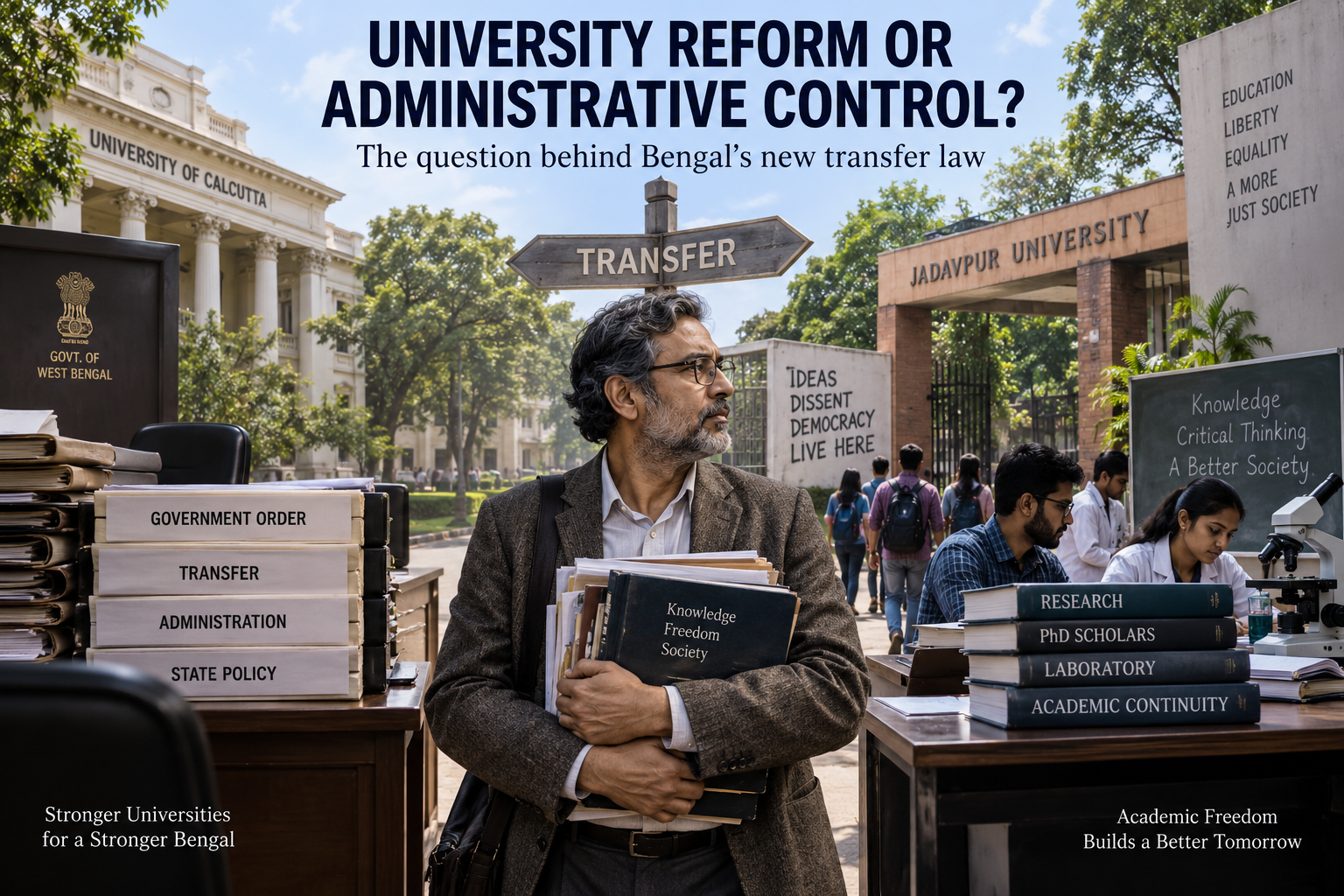
When a Professor Becomes Transferable: The Real Question Behind Bengal's New University Bill
There is a useful way to judge a new governmental power. Do not begin by asking whether you trust the government currently exercising it. Ask whether you would be comfortable giving exactly the same power to a government you deeply distrust.
That test is particularly relevant to the legislation placed before the West Bengal Assembly on 10 September 2026.
The West Bengal Universities and Colleges (Administration and Regulation) Amendment Bill, 2026 seeks to allow the state administration to transfer teaching and non-teaching employees from one state university to another. The proposed change adds a provision to Section 14A of the existing 2017 law. Reports on the Bill state that an employee's seniority would be protected and that the government would bear transfer expenses.
At first sight, this can sound like an ordinary administrative reform. It is not.
A university professor is not simply another interchangeable employee in a statewide bureaucracy. A professor may supervise doctoral students, run a specialised laboratory, manage externally funded research, build a department over decades, work within a particular university statute and participate in an intellectual community whose value cannot be measured by a personnel spreadsheet.
That does not mean professors should be permanently immovable. It means that moving them requires more thought than moving a file from one department to another.
The government's argument is not absurd
This needs to be acknowledged at the beginning.
Chief Minister Suvendu Adhikari has argued that newer universities need experienced academics. According to his explanation, senior professors could be sent to institutions in places such as Jhargram and Cooch Behar to help improve infrastructure, teaching and academic standards.
There is a legitimate policy problem underneath that argument.
Older universities accumulate institutional experience. New universities often struggle to build departments, research cultures and administrative systems. Students studying outside Kolkata should not receive an inferior education merely because their university is younger or geographically distant.
If Bengal possesses academic expertise concentrated disproportionately in a handful of institutions, finding mechanisms for sharing that expertise is sensible.
This is the strongest argument for the legislation.
The problem begins when we move from the objective to the instrument.
There are many ways to encourage academic exchange: visiting professorships, joint appointments, temporary deputations with consent, research collaborations, financial incentives, shared postgraduate programmes, faculty-development programmes and voluntary mobility schemes.
A compulsory transfer power is a much stronger instrument.
The government therefore needs to explain why weaker and more consensual mechanisms are insufficient.
Universities are not government departments
The distinction matters.
Government officers normally enter services in which transferability is an understood condition of employment.
University academics are often recruited by individual institutions under university-specific statutes and service conditions. Their professional relationship is therefore not necessarily equivalent to membership of a transferable statewide cadre.
This is precisely one of the objections raised by the Jadavpur University Teachers' Association.
JUTA argues that universities operate under their own rules and recruitment systems and that imposing an inter-university transfer mechanism could alter existing service conditions. The association has described the proposal as a threat to institutional autonomy and job security.
The Calcutta University Teachers' Association has raised another practical problem. What happens to research scholars, laboratories, infrastructure and research grants associated with a professor who is transferred?
That is not an ideological question. It is an administrative one.
Imagine a professor supervising six doctoral candidates while operating a specialised laboratory established through years of grants and institutional investment. Moving that professor may technically transfer one employee.
Academically, however, the government may be moving part of an ecosystem that cannot simply be packed into a suitcase.
The context makes the safeguards even more important
Legislation should be judged primarily by its text and effects, not by political speeches surrounding it.
But political context cannot be completely ignored when assessing the possibility of discretionary power being misused. The Bill arrives amid an unusually confrontational dispute between the state government and sections of Jadavpur University's academic and student community.
On 9 September, the Chief Minister led a Gerua Samman Yatra towards Jadavpur and used strong language against what he characterised as anti-national activity on the campus. He said his government would remove certain political tendencies and slogans from the university.

A day later, the government tabled legislation giving itself a new mechanism capable of relocating university employees.
These two facts do not prove that the transfer legislation was designed to punish Jadavpur professors.
That distinction is important.
But the proximity of the political confrontation and the administrative legislation makes demands for safeguards entirely reasonable.
When political leaders are publicly confronting a university while simultaneously expanding governmental authority over the careers of its employees, asking how that authority will be constrained is not paranoia. It is institutional common sense.
The real issue is discretion
Almost every governmental power can be defended by describing its best possible use.
® Preventive detention can stop a dangerous person.
® Internet restrictions can prevent violence.
® Surveillance can catch criminals.
® Transfers can correct staffing imbalances.
The constitutional and institutional question is never merely whether a power has legitimate uses. The question is what prevents legitimate power from becoming arbitrary power.
Suppose a professor openly criticises government education policy. Six months later, the professor is transferred hundreds of kilometres away. How would anyone determine whether the transfer reflected genuine academic necessity or retaliation?
A properly designed system would need objective criteria capable of answering that question.
For example, transfers could require demonstrable vacancies or academic need. An independent university body could participate in the decision. Reasons could be recorded in writing. Professors could receive an opportunity to make representations. Research obligations and doctoral supervision could be considered. An independent appellate mechanism could review disputed transfers.
Without such safeguards, even legitimate transfers may be suspected of political motivation. That harms the government as well as academics.
Autonomy does not mean immunity
There is another mistake worth avoiding.
University autonomy cannot mean that established institutions monopolise experienced faculty while newer universities remain permanently disadvantaged. Nor should "academic freedom" become a convenient argument against every administrative reform. Universities receiving substantial public funding are accountable to the public. Governments have a legitimate interest in ensuring that students across the state receive reasonable educational opportunities.
A professor's preference for Kolkata cannot automatically outweigh the educational needs of students in Jhargram. That would replace governmental privilege with metropolitan privilege.
This is where an Equidynamist approach becomes useful.
The competing values are real:
administrative capacity and institutional autonomy;
equitable access and academic continuity;
government accountability and intellectual independence;
mobility of expertise and stability of research.
The answer cannot simply be "government must never interfere." Neither can it be "the government was elected, therefore it may manage universities however it wishes." A durable system requires enough governmental capacity to correct genuine institutional inequality while maintaining enough academic independence to prevent universities from becoming extensions of whichever political party controls the Secretariat.
The BJP should remember the principle it would demand in opposition
There is a particularly simple test for the BJP government.
Imagine this exact statutory power in the hands of a political opponent. Imagine a future government transferring professors associated with conservative organisations, nationalist scholarship or criticism of that government. Would BJP leaders accept the explanation that experienced academics were merely being redistributed according to institutional need?
Almost certainly they would demand transparent criteria and protection against political retaliation. They would be right to do so. Those safeguards should therefore be built into the system now.
Rights and institutional protections become meaningless when political parties defend them only while sitting in opposition.
Bengal has already seen what political capture of education looks like
West Bengal does not need lessons in the dangers of politicised educational institutions.
For decades, governments of different ideological colours have been accused of influencing appointments, university administration, student politics and institutional governance.
The appropriate response to one form of politicisation is not politicisation in another colour. Changing the party flag above the machinery does not reform the machinery.
Reform means reducing opportunities for arbitrary control regardless of who governs. That principle should apply equally to the Left, the Trinamool Congress, the BJP or any government that follows them.
What the government should publish
Before implementing an inter-university transfer system, the government should make several matters explicit.
® The criteria for identifying universities requiring faculty should be publicly available.
® The criteria for selecting individual professors should also be transparent.
® Research projects, laboratories, doctoral supervision, disability, family circumstances and specialised institutional responsibilities should be considered.
® There should be written reasons for compulsory transfers.
® There should be a meaningful appeal mechanism independent of the official who ordered the transfer.
® There should be protection against transfers being used as punishment for lawful political speech, academic research or criticism of government policy.
® And the government should publish annual anonymised transfer data so that patterns can be examined.
If the objective genuinely is academic redistribution, transparency strengthens the government's case. If transparency is considered inconvenient, that itself tells us something important.
The question is larger than Jadavpur
It would be a mistake to reduce this debate to Jadavpur University. Today's government may be angry with Left-wing politics on one campus. Tomorrow another government may dislike a professor researching illegal migration, religious conversion, corruption, environmental destruction or minority rights.
Academic freedom is not designed to protect only opinions we like.
Its purpose becomes apparent precisely when political power dislikes the opinion being expressed. The institutional rule therefore has to survive changes of government.
That is the fundamental test.
Ø West Bengal does need stronger universities outside Kolkata.
Ø It does need better distribution of academic expertise.
Ø It does need accountability for publicly funded institutions.
But none of those objectives requires giving the executive an inadequately constrained power over academic careers. The government may yet design rules that address these concerns. If it does, those safeguards deserve recognition.
Until then, the burden lies with the government to demonstrate not merely that it has a legitimate objective, but that the mechanism it has chosen cannot easily become an instrument of political discipline.
Because the most dangerous governmental powers are rarely introduced by saying:
"We need this power to punish our critics."
They are introduced by saying:
"Trust us. We need this power for efficiency."
Democratic institutions are built around a more durable principle.
Do not design power around the assumption that the people exercising it will always be people you trust.
-------------------------------------------------------------------------------------------------------------------------------------------------------------------------------------------------------------------
Author Note:
This article applies the same institutional principle regardless of which political party controls West Bengal. A power that would appear dangerous in the hands of one's opponent should not become acceptable merely because one's preferred party currently exercises it.




Discussion