In this article
In recent years, outer space has emerged as one of the most important arenas of geopolitical competition. Military power is no longer measured only by the strength of an army, navy, or air force. Today, a nation's ability to monitor the battlefield, guide precision weapons, secure communications, and gather intelligence increasingly depends on its capabilities in space.
Against this backdrop, Pakistan's recent pace of satellite launches has attracted the attention of defence analysts across the region. While Islamabad officially describes these satellites as civilian assets meant for agriculture, weather forecasting, disaster management, and environmental monitoring, many strategic experts believe that their potential military applications cannot be ignored.
A Sudden Increase in Satellite Launches
For decades, Pakistan's space programme remained relatively modest. The country's national space agency, SUPARCO, often took many years to develop and launch a single satellite.
However, this trend appears to have changed dramatically.
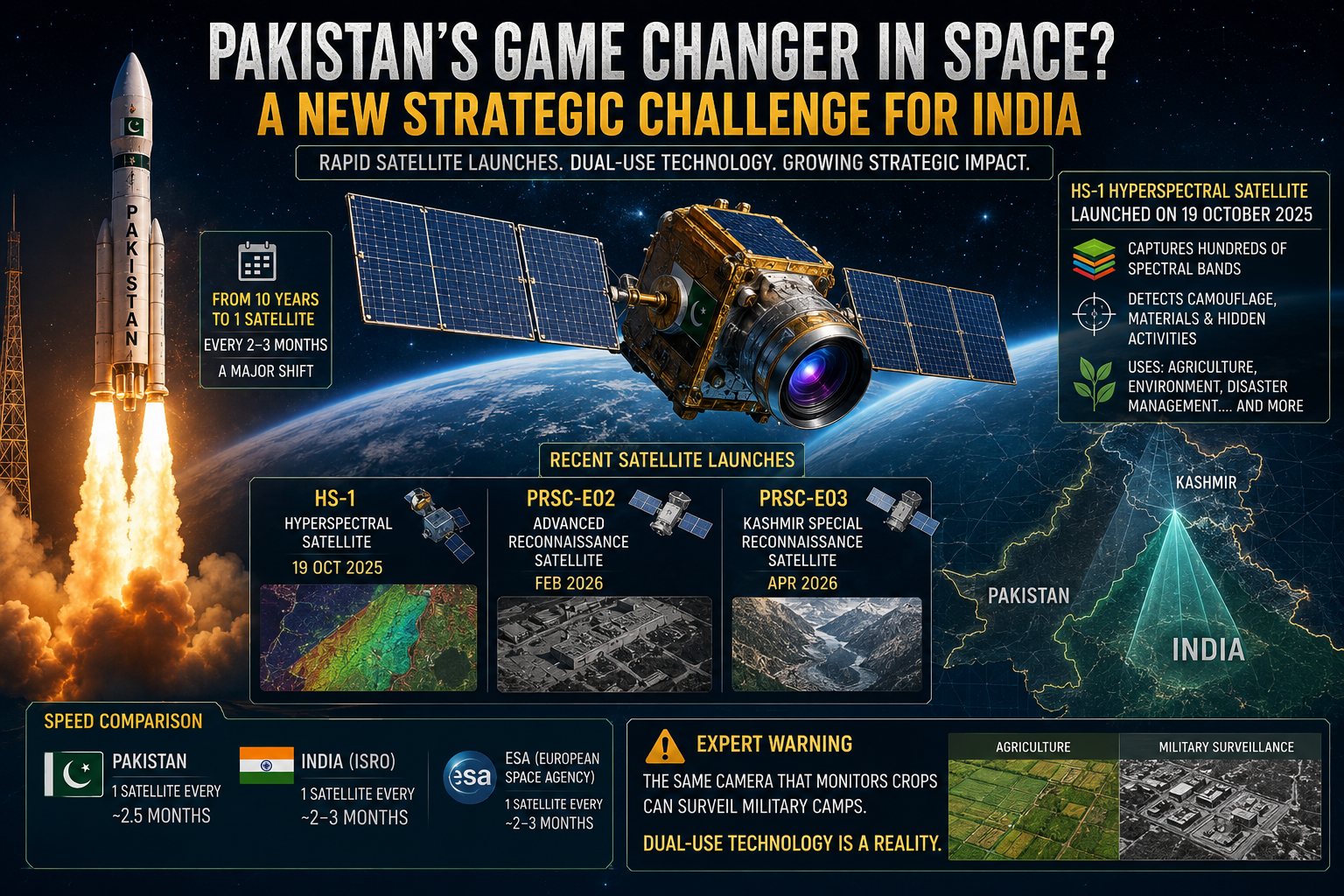
According to recent reports, Pakistan has launched multiple satellites within a relatively short period:
HS-1, a hyperspectral satellite launched in October 2025.
PRSC-E02, launched in February 2026 for advanced Earth observation.
PRSC-E03, launched in April 2026 with a reported focus on monitoring the Kashmir region.
This represents a remarkable increase in launch frequency. Defence observers note that Pakistan has gone from taking years to produce a satellite to launching one roughly every two to three months.
What Makes HS-1 Different?
Among these satellites, HS-1 has received particular attention because it reportedly carries hyperspectral imaging technology.
Unlike conventional satellites that capture images in only a few colour bands, hyperspectral satellites collect data across hundreds of spectral wavelengths. This allows them to identify materials and objects based on their unique spectral signatures.
Such technology has numerous civilian applications, including:
Monitoring crop health
Detecting water stress
Mineral exploration
Forest management
Environmental assessment
Disaster response
However, the same technology also has significant military value.
A hyperspectral satellite can potentially detect camouflaged military installations, identify hidden equipment, monitor troop concentrations, and distinguish between different materials that ordinary optical satellites might not detect.
This dual-use nature makes hyperspectral satellites strategically important.
Civilian Purpose or Military Asset?
Pakistan maintains that its recently launched satellites are intended solely for peaceful civilian purposes such as:
Agriculture
Flood management
Weather forecasting
Urban planning
Natural resource management
These are legitimate uses of Earth observation satellites, and many countries operate similar systems for exactly these purposes.
However, strategic analysts often point out that space technology is inherently dual-use.
The same high-resolution camera that helps farmers estimate crop yields can also monitor troop movements.
The same imaging system used to study forests can also identify military infrastructure.
The same mapping satellite that supports disaster relief can generate terrain models useful for military planning.
Consequently, the distinction between civilian and military satellites is often blurred.
Why the Timing Matters
The rapid expansion of Pakistan's space capabilities has drawn additional attention because of its timing.
Some defence commentators argue that the increased launch tempo following periods of heightened India-Pakistan tensions suggests a broader effort to strengthen Pakistan's intelligence, surveillance, and reconnaissance (ISR) capabilities.
Modern warfare relies heavily on satellite support for:
Battlefield surveillance
Missile targeting
Navigation
Secure communications
Damage assessment
Border monitoring
A stronger satellite network enables faster and more accurate decision-making during military operations.
China's Role
Pakistan's recent space progress has also been closely linked to its growing technological cooperation with China.
Several Pakistani satellites have reportedly been developed, launched, or supported through Chinese institutions and launch facilities.
China possesses one of the world's most advanced space programmes and has significantly expanded cooperation with Pakistan in defence, infrastructure, and space technology.
Such collaboration has accelerated Pakistan's ability to deploy new satellites despite its comparatively limited indigenous industrial base.
Implications for India
India already possesses one of the world's most sophisticated space programmes through ISRO and has extensive military space assets.
Nevertheless, the emergence of additional surveillance capabilities in Pakistan changes the regional strategic equation.
Indian defence planners must now consider:
Increased cross-border surveillance.
More frequent monitoring of military deployments.
Faster intelligence gathering by adversaries.
Greater integration between Pakistani and Chinese space assets.
These developments reinforce the importance of continued investment in India's own satellite constellations, space-based intelligence, electronic warfare, and anti-satellite defence capabilities.
The Future of Space Competition
The competition between India and Pakistan is no longer confined to land, sea, and air. Space has become an equally important strategic domain.
Earth observation satellites, communications satellites, navigation systems, and space-based intelligence will increasingly influence military preparedness in South Asia.
At the same time, it is important to distinguish between verified facts and strategic assessments. While Pakistan officially describes its satellites as civilian platforms, many experts emphasize that virtually all advanced Earth observation satellites possess dual-use potential. Whether and how these capabilities are integrated into military operations depends on broader defence policy, doctrine, and operational practice.
Pakistan's recent acceleration in satellite launches marks a significant development in South Asia's evolving strategic landscape. The deployment of satellites such as HS-1, PRSC-E02, and PRSC-E03 demonstrates a growing emphasis on space-based capabilities that can support both civilian development and national security.
As satellite technology becomes increasingly central to modern warfare, intelligence gathering, and disaster management, both India and Pakistan are likely to invest further in space assets. The challenge for policymakers will be balancing legitimate civilian uses of space technology with the strategic implications of its dual-use nature in an increasingly competitive regional environment.



Discussion