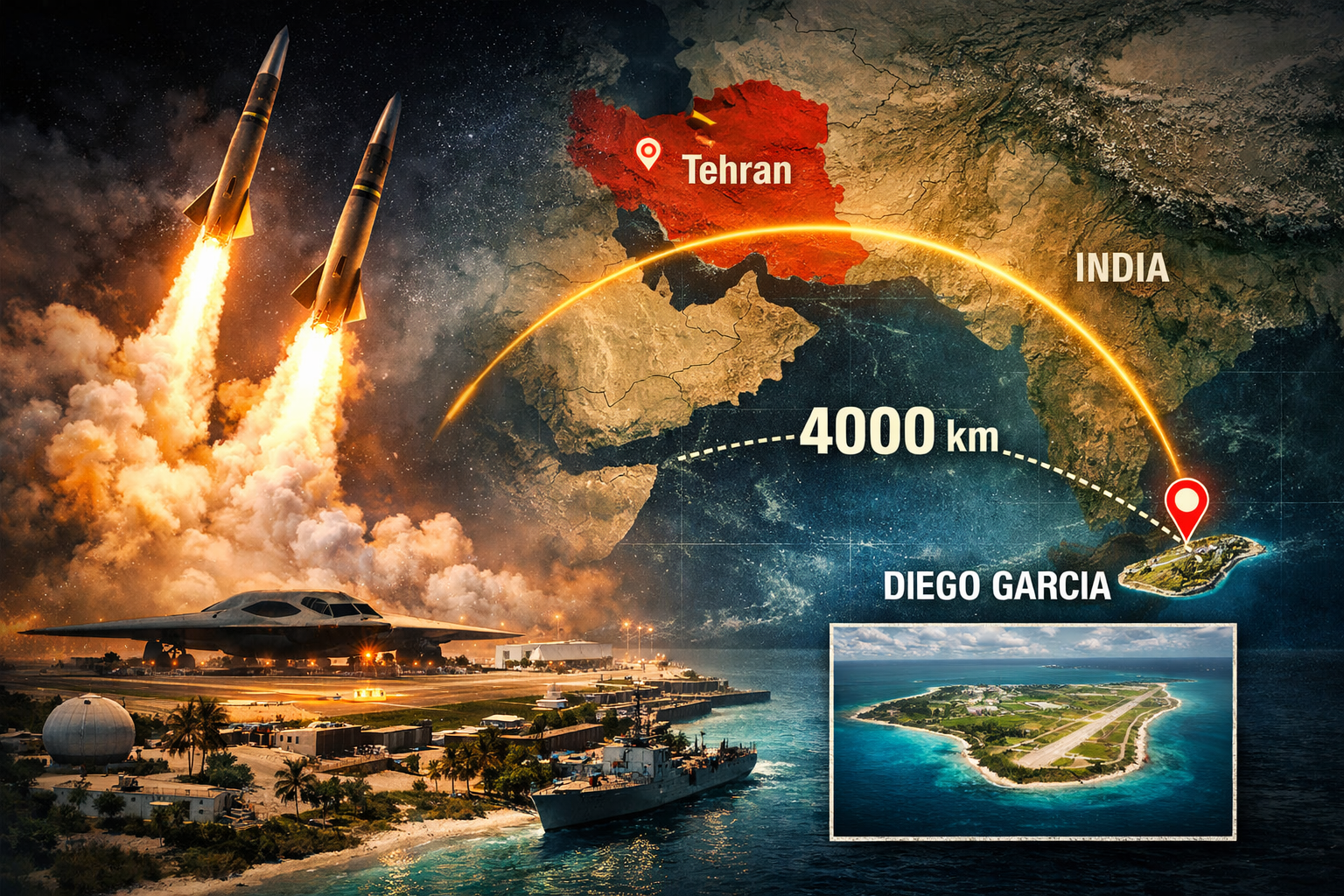
Iran launched two ballistic missiles at a United States military base this week. Both missed their target. But the trajectory of those missiles matters far less than what they were aimed at.
There is a small island in the middle of the Indian Ocean that most people have never heard of. It sits in near-total isolation, geographically closer to the Indian subcontinent than to any corner of the Middle East. No tourists visit. No headlines mention it on ordinary days. And yet, beneath that quiet surface sits one of the most formidable military installations anywhere on earth. The island is called Diego Garcia.
The story of how it became an American fortress is a dark one. In the 1960s, Britain systematically expelled the entire indigenous population of the Chagos Islands, the Chagossians, from their ancestral homeland. Families who had lived there for generations were uprooted and scattered so that the territory could be quietly handed over to the United States as a Cold War strategic asset. Entire communities were erased from the map in exchange for a runway. That runway became Diego Garcia: home to B-2 stealth bombers, nuclear-capable submarines, and guided missile destroyers. It is the dominant American military hub across the entire Indian Ocean region.
For decades, the displaced Chagossians pursued their right to return through every available legal channel. In 2019, the International Court of Justice ruled that British control over the territory was in violation of international law. Then, last year, the United Kingdom reached an agreement to transfer sovereignty to Mauritius, while retaining base access for 99 years in exchange for roughly 101 million pounds annually. Donald Trump publicly opposed the arrangement. Do not give away Diego Garcia, he warned. This week, the world got a clearer picture of exactly why he said it.
Britain formally approved American use of the base for strikes against Iranian missile infrastructure. Tehran's response was swift and direct: two ballistic missiles fired at Diego Garcia itself.
What followed upended a critical assumption. Iran's own Foreign Minister, Abbas Araghchi, had stated as recently as last month that the country had voluntarily limited its missile range to 2,000 kilometres. Diego Garcia lies 4,000 kilometres from Iranian territory. The missiles flew exactly twice the publicly declared maximum range. One failed during flight. A United States Navy warship fired an interceptor at the second. Whether that interceptor successfully connected remains unconfirmed.
But the technical outcome is almost beside the point. A 4,000-kilometre radius drawn outward from Tehran encompasses the entire Persian Gulf, the South Asian subcontinent, and a large portion of the European continent. Every military base, every allied facility, every critical energy hub within that arc now falls under a different kind of shadow.
The warheads did not land. The message, however, arrived with perfect clarity.




Discussion