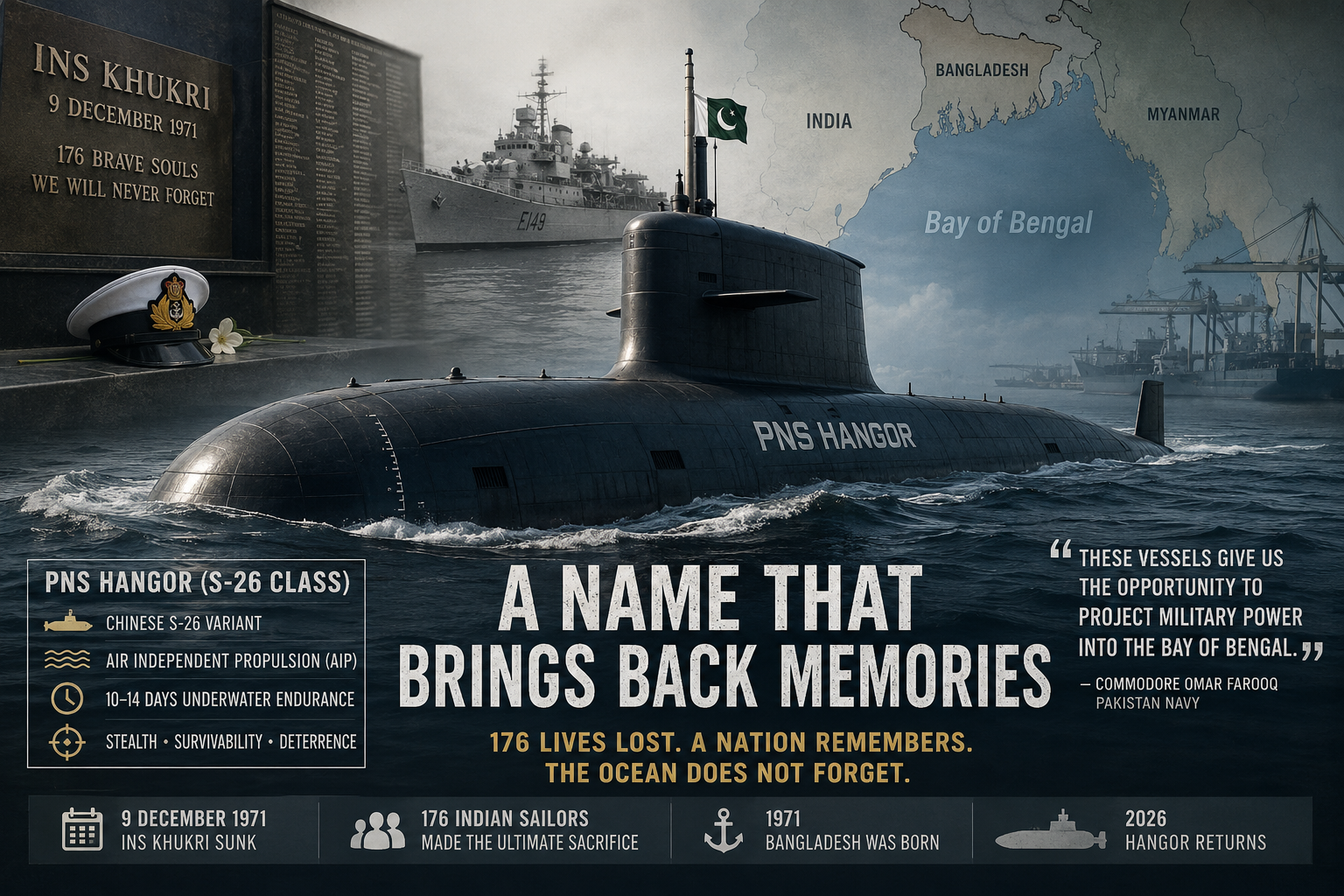
Pakistan has named its newest submarine PNS Hangor. For many people, it may seem like just another naval vessel. But for India, especially for those who have served in the Navy, the name carries painful memories.
The original PNS Hangor was the submarine that sank INS Khukri on 9 December 1971 during the Indo-Pakistan War.
One hundred and seventy-six Indian sailors lost their lives that night. It remains the only Indian warship lost in combat since Independence. While Pakistan eventually lost the 1971 war and Bangladesh was born, the sinking of INS Khukri has never been forgotten by the Indian Navy or by the families of those who never came home.
As a retired sailor of the Indian Navy, I know that behind every name engraved on the memorial was a family whose life changed forever. A wife who waited. Parents who never saw their son again. Children who grew up without a father. The pain of those 176 families did not end in 1971. They have carried it for more than five decades.
That is why naming a modern submarine after Hangor is not just a military decision. It is also a symbolic one.
Pakistan's new Hangor class submarines are based on the Chinese S-26 design. Pakistan has ordered eight of them. The first submarine was commissioned in April 2026 and reached Karachi in June.
What makes these submarines important is their Air Independent Propulsion (AIP) system. Unlike conventional diesel-electric submarines, an AIP submarine can remain underwater for ten to fourteen days without surfacing to recharge its batteries. This makes it much harder to detect and track. In simple terms, it can remain hidden for much longer than older submarines.
Pakistan has made no secret of how it plans to use these submarines. Speaking in Colombo, Commodore Omar Farooq said that these vessels would allow Pakistan to project military power into the Bay of Bengal.
That statement deserves attention.
The Bay of Bengal is vital for India. It borders India's eastern coastline and is closely linked to Bangladesh and Myanmar. It carries major shipping routes, energy supplies and strategic interests. Since the 1971 war, India has enjoyed clear maritime dominance in these waters.
However, the regional picture is changing.
Relations between Pakistan and Bangladesh have improved under the government led by Muhammad Yunus. There have been direct flights, increased military contacts and higher-level exchanges. In November last year, the Pakistani warship PNS Saif visited Chattogram. It was the first visit by a Pakistani naval warship to Bangladesh since 1971.
Viewed together, these developments suggest that Pakistan is gradually rebuilding its presence in the eastern maritime region.
This does not mean that India is vulnerable or unprepared.
The Indian Navy remains one of the strongest naval forces in the region. It operates aircraft carriers, nuclear-powered submarines, long-range maritime patrol aircraft and a wide range of modern warships. Any hostile action against India would come at an enormous cost.
The real concern is different.
A modern submarine that can remain hidden for nearly two weeks creates uncertainty during a crisis. Even if it never fires a weapon, its presence forces an opponent to devote ships, aircraft and resources to finding it. In naval strategy, uncertainty itself becomes a weapon.
India also faces its own challenge. Much of its conventional submarine fleet is ageing. The long-delayed Project 75I programme, which aims to build six new AIP-equipped submarines, has still not moved forward at the speed the strategic situation demands.
Pakistan has chosen to name its newest submarines after the one tactical naval success it achieved against India. It is strengthening its submarine fleet with Chinese technology while attempting to expand its strategic reach towards the Bay of Bengal.
History should never be forgotten.
For many, the name Hangor may represent military pride. For those of us who have worn the white uniform, it brings back the memory of 176 brave sailors who never returned to their families. Their sacrifice deserves not only remembrance, but also a renewed commitment to ensure that the Indian Navy remains prepared, modern and capable of protecting the nation's maritime frontiers.


Discussion