India’s Policy Challenges in 2025 : H1B Shock, Geopolitical Headwinds, and an Economic Crossroads
India is confronting one of the sharpest external shocks in a generation. The overnight overhaul of the US H1B visa regime, coupled with intensifying diplomatic pressures and sanctions on strategic assets, signals a complex new phase in India’s global engagement—both economically and geopolitically.
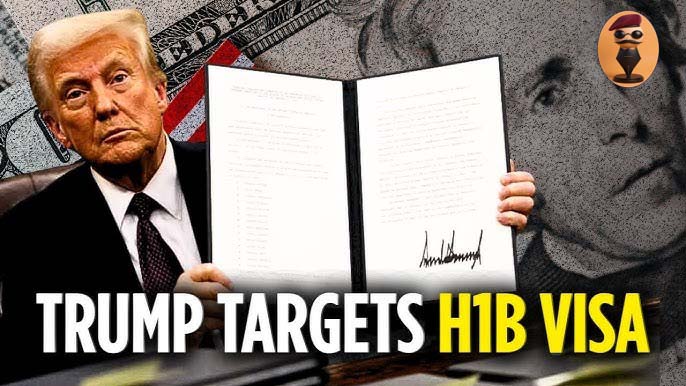
H1B Visa Fee Hike: Economic Repercussions
The abrupt announcement by the Trump administration of a $100,000 H1B visa fee for new applicants marks a seismic shift in labour mobility between India and the US. While initial fears suggested an annual recurring cost for all visa holders, US officials have clarified that the fee is a one-time payment, impacting only new H1B petitions, not renewals or current holders. Still, the increase from a $2,000–5,000 range to $100,000 is severe enough to constrict pipeline flows of Indian professionals.
This ruling reverberates heavily in Indian IT and engineering circles. Indians occupy 72% of H1B positions—over 320,000 jobs—which dwarf the next largest cohort, China, at just 12%. The new cost barrier will be felt not only by aspiring migrants but also by tech giants such as Amazon (10,959 H1B staff in the US), Cognizant (8,688), TCS, Infosys, Google, Microsoft, Wipro, and others employing tens of thousands under this program.
These firms, which have enabled India to be the world’s leading source of technology professionals, now face rising personnel costs and a sharply reduced future intake. Industry voices and India’s Foreign Ministry have flagged serious humanitarian and competitive risks, warning that tighter movement could disrupt families and corporate innovation ecosystems.
Remittance Flows Under Threat
The economic stakes are clear. India is the world’s largest recipient of remittances, which hit a record $135.4 billion (₹12 lakh crore) in FY25. A full 27.7% of these flows—amounting to about $37.5 billion—originate in the United States. These offshore incomes are crucial for state finances, supporting consumption, credit, and domestic investment, particularly in states like Maharashtra and Kerala.
If barriers prevent new workers from heading abroad, and returning H1B holders are unable to command comparable salaries in India, remittance volumes are likely to stall or decline. Furthermore, middle-class families who leveraged assets to fund overseas study—over 3 lakh Indian students enrolled in the US last year—will face a substantial setback in both career prospects and household financial stability.
Domestic Policy Dilemmas: Employment and Skills
A primary driver for emigration has been lack of adequate domestic job opportunities, quality education, and robust welfare delivery. With 11 lakh students leaving India each year for education and jobs, and US doors abruptly shutting, the pressure on India’s limited domestic employment capacity will intensify. It is unlikely that alternative markets—Japan, Germany, Singapore, or Australia—can fully absorb displaced Indian talent at the required scale.
The Indian government is convening a crisis meeting in Delhi on September 23, 2025, led by the Finance Secretary, focused on reducing policy reliance on global powers. Policymakers now face a dual challenge: reforming domestic employment and skilling systems to retain top talent, and managing the social consequences of rising returnee unemployment.
Chabahar: Sanctions and Strategic Setbacks
Simultaneously, US revocation of the Chabahar Port sanctions waiver constitutes another major policy blow. Chabahar was supposed to secure a trade and transit corridor for India to Afghanistan and Central Asia, sidestepping Pakistan and deepening commercial and strategic engagement with Iran. India has poured hundreds of millions of dollars into Chabahar since 2016—approximately ₹800 crore—with significant further investments committed.
The US action, effective September 29, 2025, places any engagement with the port under threat of secondary sanctions, undermining India’s regional grand strategy. The pullback also comes as American policy appears to increasingly reward China and Pakistan in regional power arrangements, despite prior Indian alignment with US positions on Iran.
Diplomatic Isolation and Changing Global Alignments
Recent defensive ties between Pakistan and Saudi Arabia, with speculation about nuclear cooperation and the potential rerouting of US-supplied weapons, have alarmed South Block. The rise of a potential Islamabad–Riyadh–Beijing axis reinforces a perception of regional encirclement. Already, US troops are participating in exercises in Bangladesh near the Indian border, and American influence is rising across Sri Lanka, Maldives, and Nepal.
Meanwhile, US-India friction has extended to other issues: removal from the list of favoured partner nations, higher tariffs on Indian goods, and US placement of India on a list of 23 countries “involved in narcotics trafficking or production,” once again signalling distrust.
Domestic Headwinds and Policy Failures
India’s domestic policy trajectory has compounded the challenge. Demonetisation, GST rollout, the electoral bonds verdict, the farm law protests—with over 700 deaths and eventual repeal—COVID-19 mismanagement, and expensive projects like Central Vista have taken an economic toll. Manufacturing and employment growth have stagnated, compounding the shock from global winds.
Political Fallout and Unmet Promises
Prime Minister Narendra Modi had previously pledged (2023) that H1B renewals would not require Indian citizens to go abroad. That assurance has now been overtaken by events. Opposition figures including Sachin Pilot and Rahul Gandhi have called out “weakness” and broken promises, heightening the sense of a policy vacuum at a critical juncture.
Looking Ahead: Strategic Options
India must now urgently formulate both short-term and long-term responses. The current crisis will test India’s ability to develop robust domestic systems to harness returning talent, secure new overseas opportunities, renegotiate regional alignments, and protect vital economic interests. Whether India responds with reform and diplomatic agility—or is further buffeted by global headwinds—remains the most pressing policy question of 2025.
References
Reuters – Trump to impose $100,000 H-1B fee, 19 September 2025
Economic Times – Fee applies to new applicants only, 20 September 2025
India Today – US revokes Chabahar port waiver, 19 September 2025
Drishti IAS – US Sanctions on Chabahar Port, 19 September 2025
Indian Express – US withdraws Chabahar waiver, 19 September 2025
Al Jazeera – India Foreign Ministry statement, 20 September 2025
Times of India – Implications of Chabahar sanctions, 20 September 2025
Reuters – Fee will not apply to current holders, 20 September 2025
https://www.drishtiias.com/daily-updates/daily-news-analysis/india-s-remittance-trends-2024
https://www.drishtiias.com/daily-updates/daily-news-analysis/us-sanctions-on-chabahar-port-1
https://www.politico.com/news/2025/09/20/donald-trump-h1b-visas-overhaul-00574345

Discussion